
About $50 million.
If the only thing that excites captains of industry is money, then maybe they should read this.(see below.)
There is no way to assign a money value to the love of a mother or father or child lost. That is way beyond money.
But any self-interested African businessperson or politician could notice the loss of $50 million of GDP for each Ebola death, if Ebola produces the same GDP losses that SARS is estimated to have generated. This information can help corporations to justify contributions to fight Ebola.
Excerpt from
five-steps-reduce-economic-impact-ebola
"There have been several studies of the economic impact of the 2002-3 SARS epidemic, but the one I find most useful is a study by Lee and McKibbin entitled Estimating the Global Economic Costs of SARS (also available as a Brooking working paper here). The authors use a dynamic computable general equilibrium model to project the eventual cost of the SARS epidemic for individual countries and the world as a whole.; Figure 3 reproduces their graphical results for two alternative assumptions regarding the expectations of economic decision-makers (whom Lee and McKibbin call the “economic agents”).
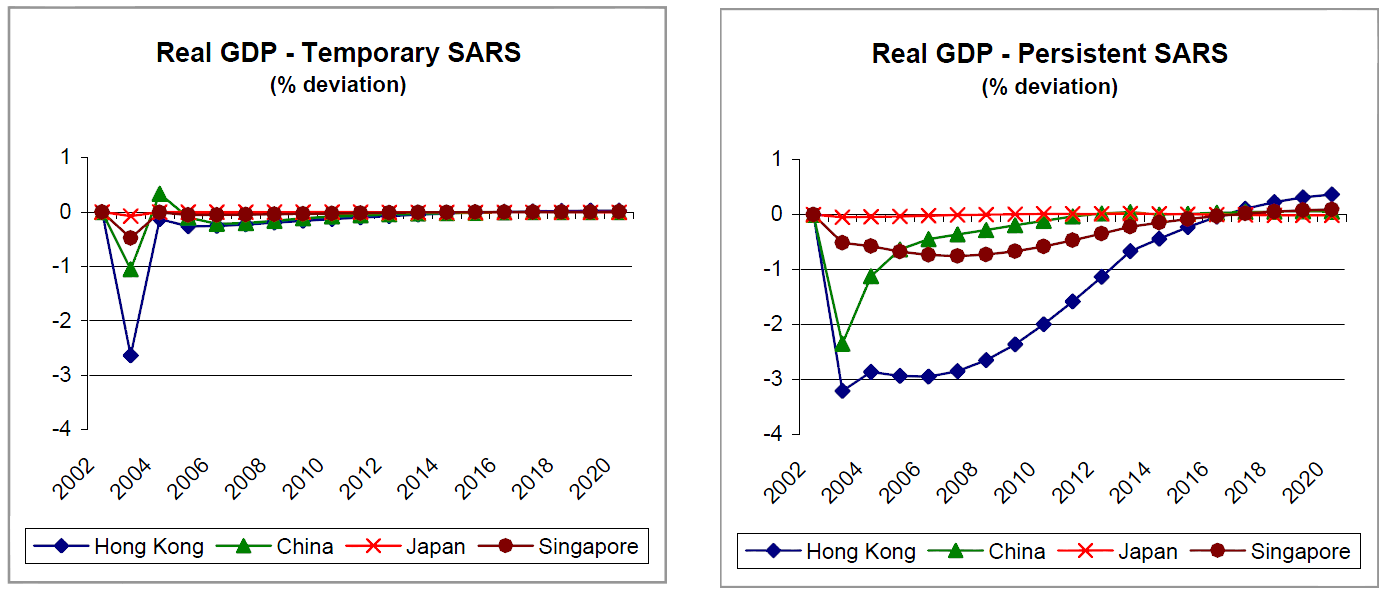 Figure 3. Impact on Gross Domestic Product of the SARS epidemic depending on whether economic decision-makers expect the risk of the disease to vanish or to persist. (Source: Lee and McKibbin) Click image for larger version.
If the millions of individual decision-makers believe that the SARS epidemic is a rare anomaly, the authors’ model projects the total worldwide cost of SARS in a single year, 2003, to be $40 billion. Since there were only about 8,500 cases of SARS and about 800 deaths, that works out to $4.7 million per case or about $50 million per SARS death. This amount is of course far more than the lost economic product of the 8,500 sick people. It results from the reductions in trade, investment, tourism, business travel and service sector activity caused by either personal fear of SARS or fear that others will fear SARS. The left panel of Figure 3 shows the resumption of normal economic activity if that fear quickly dissipates by 2004."

No comments:
Post a Comment