Tuesday, October 28, 2014

Barron's blogger Ben Levisohn: how to pick "Ebola plays" - winning stocks


A "play."

An example of how some people plan to make money off of Ebola now that it threatens the world and now that potential deep-pocketed buyers have emerged.


Although I understand that the wheels of capitalism must turn in their own way before effective vaccines can be developed, and how funds must be raised for their development, but I simply cannot help being a little nauseated by Ben's callous choice of words.

1 million Chinese live in Africa


spiegel.de/international/world/investment-with-strings-attached-cables-reveal-resentment-at-chinese-influence-in-africa-a-733870.html

10,000 of them are in Liberia, Sierra Leone, and Guinea.

Business Insider:
chinas-companies-billionaires-must-step-up-to-fight-ebola-wfp-2014-10#ixzz3HSoZkQzW


In the background:

The New Dawn (Monrovia)

26 FEBRUARY 2014

Liberia/China Sign U.S.$13.5 Million Pack


The Governments of Liberia and China took their bilateral relations to another level Tuesday when the two countries sealed a US$13.5 million Economic and Technical Cooperation Agreement.
Under the agreement China will provide the gratuitous assistance of US13.5 million about (80 million RMB Yuan) to Liberia. Foreign Minister Augustine Kpehe Ngafuan signed on behalf of Liberia while Chinese Ambassador to Liberia, H.E. Zhang Yue signed for his government.
A Foreign Ministry release, said the US13.5 million will be used to cover expenses of projects to be agreed upon by the Governments of Liberia and China.
Speaking at the signing ceremony, Foreign Minister Augustine Kpehe Ngafuan lauded the People's Republic of China for the assistance and stated that the signing of another agreement between the two governments is historic following the appointment of a new Chinese Ambassador to Liberia just a few weeks ago.
While thanking the new Chinese Envoy, Minister Ngafuan stated that Liberia looks forward to signing more agreements with China, which will bring mutual benefits for the two nations.
"We are happy that you have come with new vigor, and that we at the Foreign Ministry will make sure that your tour of duty will be fruitful and rewarding." the Minister added.
Earlier, Chinese Ambassador, H.E. Zhang Yue, expressed joy over the signing and stated that the Government of China values its relations with Liberia stressing that the signing of this agreement and the recent provision of technical equipment to the Defense Ministry signifies good news for Liberia-China cooperation.
Ambassador Zhang Yue also expressed his government renewed commitment to enhancing cooperation with Liberia and support the country's development program with the aim to assist the livelihood of the Liberian people, adding "we can work together cooperatively with Liberia using our resources to enhance cooperation."

Every SARS death cost GDP an estimated $50 million, all told. How much per each Ebola death?


About $50 million.

If the only thing that excites captains of industry is money, then maybe they should read this.(see below.)

There is no way to assign a money value to the love of a mother or father or child lost. That is way beyond money.

But any self-interested African businessperson or politician could notice the loss of $50 million of GDP for each Ebola death, if Ebola produces the same GDP losses that SARS is estimated to have generated. This information can help corporations to justify contributions to fight Ebola.


Excerpt from
five-steps-reduce-economic-impact-ebola

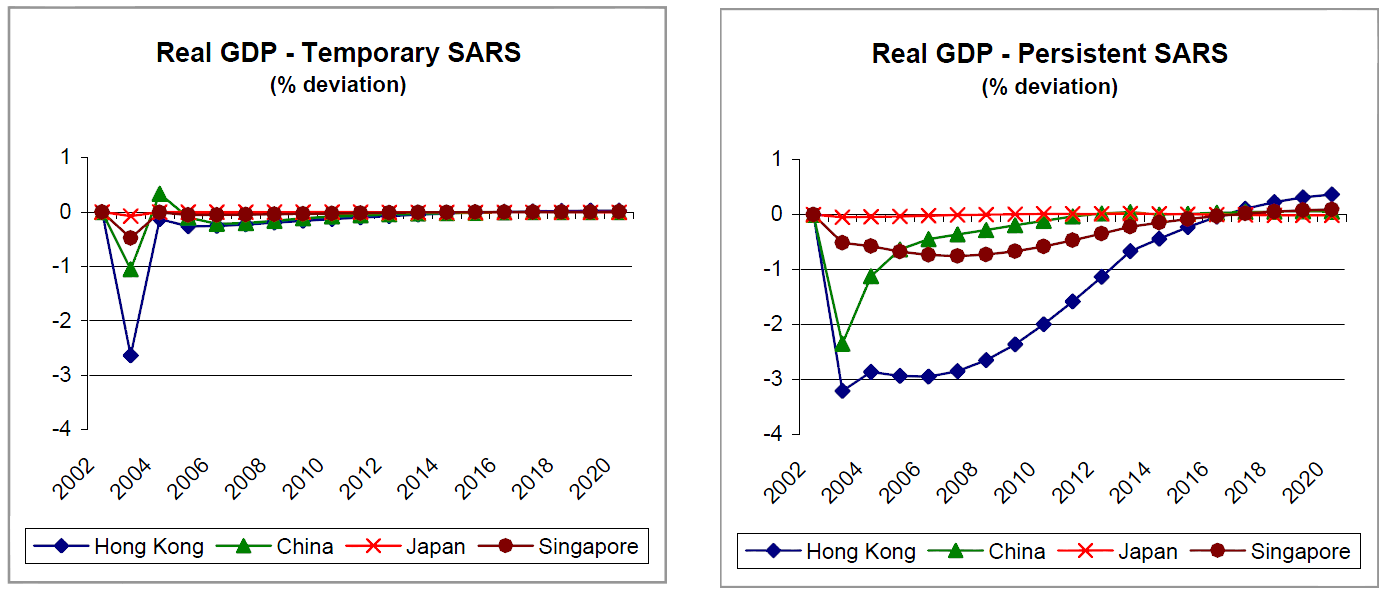
"There have been several studies of the economic impact of the 2002-3 SARS epidemic, but the one I find most useful is a study by Lee and McKibbin entitled Estimating the Global Economic Costs of SARS (also available as a Brooking working paper here). The authors use a dynamic computable general equilibrium model to project the eventual cost of the SARS epidemic for individual countries and the world as a whole.; Figure 3 reproduces their graphical results for two alternative assumptions regarding the expectations of economic decision-makers (whom Lee and McKibbin call the “economic agents”).
SARS GDP impactFigure 3. Impact on Gross Domestic Product of the SARS epidemic depending on whether economic decision-makers expect the risk of the disease to vanish or to persist. (Source: Lee and McKibbin) Click image for larger version.
If the millions of individual decision-makers believe that the SARS epidemic is a rare anomaly, the authors’ model projects the total worldwide cost of SARS in a single year, 2003, to be $40 billion.  Since there were only about 8,500 cases of SARS and about 800 deaths, that works out to $4.7 million per case or about $50 million per SARS death.  This amount is of course far more than the lost economic product of the 8,500 sick people. It results from the reductions in trade, investment, tourism, business travel and service sector activity caused by either personal fear of SARS or fear that others will fear SARS. The left panel of Figure 3 shows the resumption of normal economic activity if that fear quickly dissipates by 2004."

Cocoa supply chain angst and the Ebola Private Sector Mobilization Group (EPSMG)


Cocoa.


how-ebola-is-affecting-the-supply-chain/

...Of course, the Ebola epidemic is not only affecting the cocoa supply chain. Liberia is a big exporter of  rubber and iron ore. Guinea’s main export is aluminium ore, while Sierra Leone is major exporter of iron ore, titanium ore and cocoa.

A group of major employers in Liberia have formed an organisation, the Ebola Private Sector Mobilisation Group (EPSMG), to help combat the spread of the virus.
The group represents 45 the largest private employers in West Africa including: ArcelorMittal Liberia, Equatorial Palm Oil, Exxon Mobil, Golden Veroleum, Putu Iron Ore Mining, Total Liberia, Monurent, Aureus Mining Company, Chevron and Price Waterhouse Coopers.
Marcus Wleh, head of external affairs and corporate responsibility at ArcelorMittal Liberia, who chairs the EPSMG, said the group will focus its activities on four areas of concern: social mobilisation and awareness, logistics, public partnership and early recovery.
Apparently, this kind of private sector activity is unprecedented in Liberia. Dr Lawrence Bropleh, head of legal affairs and corporate communications at Lonestar MTN, said: “Everyone asks what the private sector is doing, but for the first time we have a cohesive and holistic effort from the private sector to help the fight against Ebola.”

Samsung, main investor in Sierra Leone's Baomahun gold mine, holds $60 billion in cash


Gold in the Sierra Leone mountain at Baomahun

We presume that Samsung needs the gold of Sierra Leone-- to use in its electronics products that have earned it enough to create a $60 billion cash stash.


Baomahun gold project in Sierra Leone which keeps it on track for a first gold pour in H2 2015.
2014: The [South Korean] government of President Park Geun Hye this month published initial plans for a 10 percent tax on what it says are excessive fund hoards that should either be spent on wages and investment or distributed to shareholders. The levy, which needs lawmakers’ approval, could affect Samsung, which had the equivalent of $60 billion in cash and short-term investments at the end of June. 

Samsung donates 3,000 smartphones to help Ebola fight

The company says that the phones, worth about $1 million, will be used in 60 Ebola medical clinics in Guinea, Liberia, and Sierra Leone.

Sierra Leone News: Cluff Gold SL donates Ambulance, cash to Ebola Task Force

pres. koromaCluff Gold Sierra Leone, a (subsidiary of Amara Mining plc that is listed on the London Stock Exchange), [owner-operator of the Baomahun gold mine] 
a leading Gold Mining Company in Sierra Leone, has donated Le40million $9,140 and a Toyota Land Cruiser to the Ebola Task Force through, President Ernest Koroma at State House.


Gold mine in Sierra Leone

Sierra Leone News: Cluff Gold feasibility study confirms robust financial returns at Baomahun

Alusine JallohAmara Mining plc, the dual AIM and TSX-listed West African focused gold mining company has announced the results of its Feasibility Study (“FS”) for its 100% owned Baomahun Gold Project in Sierra Leone which outlines a robust and economically viable project.  According to the study the Baomahun Project is expected to generate a post-tax Internal Rate of Return (“IRR”) of 22% and a post-tax NPV of US$127 million at a discount rate of 8% and a gold price of US$1,350/oz whilst the Life of mine (“LOM”) average total cash costs of US$799 per ounce (inc. royalty and refining)
The Maiden Mineral Reserve defined for Baomahun of 1.21 million ounces (23.3Mt at 1.62g/t) at a gold price of US$1,100oz. Amara Mining intends to immediately investigate the recommendations generated by the FS to optimize capital intensity, initial capital outlay and payback period.
The FS is based upon an open pit operation with a mine life of 11.5 years and a processing capacity of 2 million tonnes per annum (“Mtpa”) through a conventional carbon-in-leach (“CIL”) plant.
Average production is expected to be 148,550 ounces per annum over the first six years at 2.53g/t head grade, with production of 203,970 ounces at 3.90g/t in the first year generating strong cash flow.
Peter Spivey, Chief Executive Officer of Amara, commented that “the Feasibility Study has demonstrated the economic strength of the Baomahun Gold Project. We intend to maximize the opportunity for further upside through optimisation which, in light of the current poor equity valuation environment and uncertainty over the outlook for the gold price, is a prudent strategy and in keeping with our approach of lowering risk.
This work he said will focus on opportunities highlighted by the FS including enhancing capital intensity, reducing initial capital outlay and shortening the payback period for Baomahun through exploring scenarios for a smaller plant and higher grade open pit, an earlier underground phase and hydro-electric power. We expect this to demonstrate an even more robust and deliverable project. He added
“Having proven the viability and value of Baomahun, we will now begin discussions with our partner, Samsung, and other interested parties with regards to funding the development in a non-dilutive fashion. The delivery of the Baomahun FS is an important step in demonstrating the intrinsic value in the Company’s portfolio of assets.”
It is estimated that Average gold production of 148,550 ounces per annum over the first six years at an average grade of 2.53g/t, with production of 203,970 ounces in the first year at 3.90g/t. Probable Reserves of 1.21 million ounces (23.3Mt at 1.62g/t) at a gold price of US$1,100 per ounce and Average recovery of 93.4% through a 2 Mtpa processing plant incorporating single stage crushing, SAG milling and a CIL circuit
The Project is fully permitted with a Mining Lease granted on 11 July 2008 for a period of 25 years and an Environmental Permit granted on 19 April 2012 with a financial Post-tax IRR of 22% and NPV of US$127 million at an 8% discount rate and a US$1,350 per ounce gold price.
A Strategic alliance with Samsung C&T Corporation (“Samsung”) with the potential to provide cornerstone financing for Baomahun project, capable of satisfying a significant portion of the total Baomahun financing needs
When contacted the Country Manager of Cluff Gold Sierra Leone Alusine Jalloh said that the company has completed exploration operations within the Baomahun Concession area after several years and believes there is huge gold potential for mining operations.
He said according to the feasibility study of the exploration there is maximum deposit of gold within the Cluff Gold concession area and the company is determined to commence mining after the completion of negotiations with the government for a mining lease agreement.
He said two major events occurred this year that resulted in staff reduction. The first was the completion of exploration work within the Baomahun concession area and the second was the sharp decline of the price of gold world-wide. Those two happened almost at the same time and hence the company was forced to reduce its workforce.
The Country Manager of Cluff Gold also said that despite the slump in the price of gold around the world, which seriously affected the company’s operations in Burkina Faso, “we remain committed and determined to start mining gold at Baomahun.”
He expressed gratitude to the local community for supporting Cluff Gold operations over the years within the Valunia Chiefdom and assured them of continuous collaboration for a successful investment that will create foreign direct investment for economic growth and sustainable development of the country.
Friday September 06, 2013